Notice:
I did not install MathJax yet, I will do in the future. It would let me more freely math.
Disclaimer:
This post is meant to share some observations I had recently, I hope it is helpful. If so, please cite this.
Synopsis:
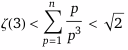
Bounding the following inequality between the Apery's constant and square root of two gives the following inequality of the following partial sum, with n in non-zero rational numbers:
Developing further, we notice that it is actually an harmonic number of n to the power of two:

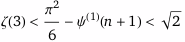
And thus alternate form of the following:
Observations:
- [1] We seem to have found in the third alternate form, a form of inequality involving zeta of two. Alongside the nth derative of our digamma function, which then turns out to be simplifiable to the generalized harmonic number above.
- [2] Rewriting (3) to:

Simplifies both left sides to the following inequality (since n is a positive rational number here):

- [3] By then noticing pi being raised to the power of two, we can explore an inequality that's lesser than pi, involving the square root of the left hand side of (5).
Going Forward:
More are to come for this, stay tuned. It may continue or may not, depending on whether this worth exploring.
References:
- [1] Apéry's original 1979.
- [2] ζ(2) = π²/6.
- [3] Books such as Basic Number Theory by Andre Weil.